Saturday, July 14, 2012

How Not to Write a Novel

This is a blatant attempt to distract you all from the measurements I posted in my last update.

I've been working on a novel for a while now.  The basic story is the origins of the narrator in "Lennon's Glasses," although the novel actually revolves around the Bloomsbury Group, featuring Virginia Woolf and her crowd.  I have started the first chapter a couple of times, but each time I make it through the first scene and then get totally stuck on what should happen next.  So I decided that I am the sort of writer who needs to work from a pretty extensive outline. Like many writers, I have a ton of writing books in my personal library, so I've been working my way through all the ones that address plot planning to try to find a model that would work well for me.

I'd narrowed it down to three:

  1. Writing the Breakout Novel Workbook by Donald Maass
  2. First Draft in 30 Days by Karen Wiesner
  3. The Plot Whisperer by Martha Alderson
I put the question to my husband, who immediately voted for The Plot Whisperer, as I've been telling him about it as I read it.  Maass's Writing the Breakout Novel (not the workbook version) is a pretty interesting deconstruction of what makes successful novels; I read that book, and then also read several of the "breakout novels" he identifies, and agreed that they were pretty compelling reads, sometimes even against my own inclination.

Who doesn't want to write a breakout novel? I picked up the workbook and opened it to the first sets of exercises to read them aloud to my husband. 
Exercise:  Adding Heroic Qualities
Step 1: Who are your personal heroes? Write down the name of one.
Step 2: What makes this person a hero or heroine to you? What is his or her greatest heroic quality? Write that down.
Step 3: What was the moment in time in which you first became aware of this quality in your hero/heroine? Write that down.
Step 4: Assign that quality to your protagonist.  Find a way for he or she actively to demonstrate that quality, even in a small way, in his or her first scene.  Make notes, starting now.  (note that there are two lines allotted for this step)
Follow-up Work: Prior to the climactic sequence of your novel, find six more points at which your protagonist can demonstrate, even in a small way, some heroic quality.
Exercise: Opening Extra Character Dimensions
Step 1: What is your protagonist's defining quality; that is, how would anyone describe your protagonist? What trait is most prominent in his personality? What kind of person is she? Write that down.
Step 2: Objectively speaking, what is the opposite of that quality? Write that down.
Step 3: Write a paragraph in which your protagonist actively demonstrates the opposite quality that you wrote down in step two.  Start writing now.
Follow-up work: Define a secondary character quality; write down its opposite; write a paragraph in which this character demonstrates the opposite secondary quality.  In the same way, open third and fourth additional dimensions to your protagonist.

I'm not totally sure I could name my personal heroes off the top of my head, or that my personal heroes are even remotely relevant to my protagonist's journey, but the entire thing sounded dry, mathematical, and arbitrary.  Jeff wanted me to toss it right out.  

I can't toss a book, but if anyone wants the workbook and the companion text (which is much better and more fully fleshed out), speak up and I'll get it to you.

For the time being, I'm going with Martha Alderson, The Plot Whisperer. The book is full of useful worksheets for planning a novel, and she has a workbook out that I might investigate as well. Since I'm in reinvention mode, I'd like to really kick my novel into gear now and ratchet up the word count on the first draft.  

If you are interested in following my progress, I'll be posting more of my fiction work at Cindy Ash, Writer.  That site is more of a journal/tracking site than a proper blog, so the only links and pictures that will be posted there will be for my own convenience, although friendly types are welcome to follow along and share encouragement, advice, and gentle suggestions.

Are you working on a big project?  What resources have you found to be laughably unhelpful?  Please share them in the comments!

Omphaloskepsis: July 14 Update

My efforts to disrupt my reading-while-eating habit have met with mixed results so far.  I had two successful days in a row of managing my mid-day portions, but I couldn't bring myself to leave the book in another room.  The success was in committing to a specific lunch and eating only that amount.  I just can not seem to relax without the book.

For the coming week, I'm going to try making myself a cup of tea or a glass of cider vinegar tonic (a tablespoon of Bragg's apple cider vinegar with a couple of drops of stevia in a tall glass of cold water) and reading my book while I sip my beverage, then put the book away for my meal.

The only exercise I got this week was a hike with the kids.  It was a nice amount of exercise, and if I could do that three times a week it would have been great.  Next week I will exercise at home, using my DVDs, the Kinect, or the Wii, at least three times.

Measurements...
I'm not thrilled to be posting these, but perhaps it will spur me to not cheat for next week:
Weight: 161 pounds
Narrow part of my waist: 31 inches
Hips: 41 inches
Thighs: both are 23.75 inches

I'd like to lose 2.5 inches each on my waist & hips, and a full inch on each thigh.

Be kind, people, I'm having a moment here.

Friday, July 13, 2012

Home Sweet Home

Back in the day just a bit...
(arriving in Hawaii in December 1998)
Sunday night we got home from a two-week vacation visiting family on the East Coast. I'm especially happy to be living out of my closet again, rather than a suitcase, as I finally figured out how to pack pretty much appropriately for a long trip.

In preparation for our trip, I spent a lot of time on Pinterest and Google trying to figure out how to pack most efficiently.  We spent one week in Hilton Head with my family, where the dress was primarily swimsuits, with a couple of very casual outfits for meals and biking on the beach, and three rather nicer occasions when we went out in couples, took my parents out to dinner, and had a "Ladies' Day" with my mom and sisters-in-law.  The second week, spent with my husband's family, was a little bit less casual -- I wore at least a little bit of makeup every day -- but also more consistent in terms of wardrobe requirements.

Typically when I pack for this annual trip I am edging past 48 pounds on my suitcase (for the outbound).  I pack ten outfits and 4+ pairs of shoes, not including sneakers & flipflops, way too many toiletries and quite a lot of acessories.  Add in shopping on the trip and I usually spend the night before departure frantically reallocating weight among the family's suitcases to get the four of them to weigh in under 50 pounds.

Oh, and to spare any of you the pain I have felt when checking in a bag only to find -- after the other three have been sent down the conveyor -- that my bag is 52 pounds, I recommend a luggage scale.  (I have this one and have had no problems with it, but I don't want to recommend something with such poor reviews).

If you have ever tried to use Pinterest to get pointers on how to pack for a vacation, you've most likely come across this picture, which has been spammed from here to eternity:

I'm pleased to share the actual source of this image:
rockedit.blogspot.com

I love the concept, but I didn't feel like this method was going to work for me on this particular trip.  For one thing, my activities from one day to the next were going to be fairly uniform, and the wardrobe laid out here was actually too varied for my purposes.  For another, I am addicted to lots of color, and two weeks of neutrals leavened by only one color... well, I can think of no quicker route to shopping mayhem than to restrict myself to one color, even if it is a favorite.  And finally, I'm sorry, but there is NO WAY I'm wearing a scarf of any kind in South Carolina in July.

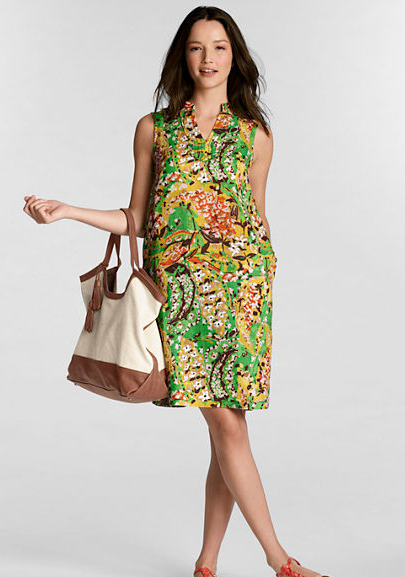
Since my thighs are no longer worthy of short shorts, I decided on a wardrobe of 4 daytime dresses, 2 pairs of very casual shorts plus a couple of t-shirts, one pair of white jeans (which I wore on the plane with a cardigan and a tank top) and two tops to alternate with the jeans, and two very old t-shirt dresses which doubled as swim cover ups.  For shoes, I wore a pair of very comfy slip-on sandals with a two inch wedge and brought my favorite wedge sandals (seen here) a pair of Privo! sneakers similar to these, except mine are awesome orange and about six years old, and a pair of black flip flops.

Lands End Ponte
Doesn't this look fun?
My trip wasn't quite so glamorous.
Lands End Linen V-Neck Dress
mine was navy
Lands End Cotton Dress
mine was the toffee dot
My FAVORITE:
Lands End Linen Caftan


So how did it work out?  Great!  With the caveat that I did have to do laundry near the end of each week. Which was fine because when I used to overpack I was doing laundry for the kids anyway, and I always had unused things at the bottom of my suitcase that didn't seem to quite work.  I could have used one extra pair of skinny jeans to bridge the gap between dress and shorts for the second week of our trip, but not so much that it would have been worth making the purchase.  (BTW, I have just about decided that the skinny jean trend needs to die almost as badly as the platform wedge, but since I still have hopes of regaining my youthful figure I'm not all the way there... yet.)

Toiletries and accessories are another area where I usually run into trouble, but this year I managed to keep the toiletries to a reasonable quantity, all things considered.  Accessories I reduced to very near nothing at all; I could have brought nothing but two pairs of earrings and I would have been just fine.  

For the kids:  this year I let my daughter pack for herself, and only looked back through her bag to approve her choices.  She overpacked.  Perhaps someday she'll read my blog and learn from my mistakes. (!!)  For my boys I did pack too many shirts, although considering how difficult it has been to civilize my sweet older son it's not unreasonable to think he might go through 3 shirts a day.  I had almost enough shorts for each of them, but since they are overlapping a little in sizes and my husband never could tell whose were whose, they ended up wearing one another's clothes interchangeably and it worked out.  In fairness, the boys don't seem to know whose clothes are whose either, so I might be a little nit-picky in that regard.

I can't describe what a win it feels like to have finally packed a successful suitcase. I felt as light as when we got the gigantic donation picked up from our driveway and I knew I wouldn't have to worry about caring for all that stuff any more. Each year that we travel I feel slightly less like a sherpa.

And one more time, THANK YOU to all our fantastic family for putting us up and feeding us and giving us such wonderful memories.


Monday, July 9, 2012

Omphaloskepsis, Part 1


After a lovely two-week vacation during which I gave myself permission to eat the potato chips (and pretty much everything else that crossed the threshold), it is time to return to ordinary life.  Including, alas, facing the fact that all of the pictures that were taken for our parents' Christmas cards are going to include me looking pretty saggy.

Good thing Christmas comes every year.  I have some time to do something about it, assuming the Mayans were wrong about 2012.

I did take the time to identify several habits that are contributing to the things about my figure that I find unsatisfactory.  And I should take a moment to point out that while I'm complaining about my appearance in the family portraits at the moment, what I am also unhappy about is my overall fitness.  I am not an athlete, but I have had periods in my life when I was very fit and pleased with what my body could do.  For several years I took yoga classes, which was awesome not only for my flexibility but also for my sense of calm and my feelings of connectedness in my spiritual life.  At several different times in my life I have been a fairly strenuous walker, at my best covering as much as 6 miles a day, three days a week.  When I trained for the Susan G. Komen Breast Cancer 3 Day, I walked 6 miles a day during the week, and then 10-17 miles on Saturdays.

What has happened to me?

Here are a few habits I have fallen into that keep me from being the person I want to be:

  1. Not exercising regularly.  This is bad for me not just because I'm not burning off the bad food choices I make, but because I'm depriving myself of the satisfaction that kept me from overeating in the first place.  I gradually gave it up when the house was on the market, after one too many notices that the house was going to be shown during the time I had designated for exercise.
  2. Reading while I eat.  I definitely, definitely overeat when I'm not focusing on my food.  I noticed this one the most while I was on vacation; the thought of not reading while I munched my lunch, quietly, away from other people, was so uncomfortable that it almost sent me into a panic.  This is where I will begin applying what I've learned from The Power of Habit
  3. Not having a plan for my breakfasts, lunches, and snacks.  I have no problem with portion control at dinner time, but my earlier meals are sometimes a little haphazard.  Because of poor planning during those times of day, I often go too long between meals and then end up starving and shaking so badly that I feel like I have to stuff myself during the mid-afternoon.  I'm hoping that the measures I'm considering for Item #2 will help alleviate this problem.
  4. Too much alcohol.  It's only a glass or two a night, but considering what sugar does to one's metabolism, and also the fact that I can't drink when I'm training for something because it makes me feel horrible, I probably should cut back.  A lot.  Although that might be a habit I tackle later, when I've worked out to do about the reading while I eat thing.
In The Power of Habit, Charles Duhigg describes a habit loop, whereby a cue triggers a behavior or routine, which, when completed, is rewarded by a kind of neuro-chemical shot.  The initial description of the loop is established by recounting an experiment in which a rat is placed behind a closed gate, which opens with a click.  The rat then makes its way down a very simple maze to find a bit of chocolate, which it then eats.  Over time, the chocolate becomes associated with the click, in what most people would describe as a Pavlovian response.  Duhigg illustrates it thusly:


In my case, the need to eat a meal when I am alone (or when I wish I were alone) is the cue or click.  Reading the book while eating is the routine.  I have identified that a sense of relaxation is the reward, and that when I am anxious or reluctant to take on a project (like the laundry) that is on my agenda, then I will stretch out the experience of relaxation by adding portions to my meal.  Sometimes, a lot of portions.  The challenge will be to figure out how to meet my need for relaxation (in spite of the difficulty I find in relaxing generally) without continuing the problematic behavior.

According to Duhigg, you can change a habit, but you can't kill it.  So I won't be able to simply stop reading while I eat and expect that to go well.  Neurologically, I need something to disrupt the routine part of the loop while retaining the reward.  To do this, I'm going to have to poke around a little bit.  

Duhigg also stresses the importance of having a plan for tackling a behavior.  I don't really have one.  But lucky me, some of the other ingredients for successfully altering habits are including a community and Belief.  You, lovely readers, are my community, and Belief... well, that is going to have to develop.  (In the book, Belief generally came about as a result of some sort of crisis.  I'm not sure unflattering family pictures are enough of a crisis to generate the belief necessary to make this happen, but here's hoping.)  

By tomorrow I will have a Plan A to share, as well as a few measurements to incite me to victory.  I will also share some highlights of going on vacation for 2 weeks (I flew with an underweight suitcase, hurray!!) and of coming home (I still love my baking soda and my reusable grocery bags!).  And later this week, I will be introducing a new tab to the blog... are you on the edge of your seats?

Thanks for being my community, friends!

Monday, July 2, 2012

Putting It Into Practice

So I found The Power of Habit to be pretty empowering.  Just how empowering, I'm ready to put into practice.   Here's the deal:  I'd like to lose eight pounds, and if I'm successful, then an additional eight pounds, for a total weight loss goal of sixteen pounds.  I know from the last few months that simply wishing the weight away doesn't work.  Unfortunately.  However, I think that this time I have a better understanding of what I need to do to succeed.

Thursday, June 28, 2012

Review: The Power of Habit: Why We Do What We Do in Life and Business

Every morning when I get up, I stagger to the kitchen, get out my stainless steel travel mug and set it on the counter next to the coffee pot, then get out the half and half and pour in an amount that is determined by the place where the cup narrows to fit the cupholder in the car, put the half and half away, and then pour the coffee on top.  Then I rotate the cup so the handle is on the right side and ease the lid on so that the coffee doesn't splash through the sipping hole.

Why do I do it that way?

Charles Duhigg knows.

More precisely, Charles Duhigg knows which parts of my brain direct those functions and the mechanism by which that sequence of events became automatic.

The Power of Habit: Why We Do What We Do in Life and Business, by Charles Duhigg, came to my attention through an NPR interview, when I caught a segment of the conversation in which he describes his efforts to stop a mid-afternoon chocolate chip cookie habit.  He uses that example in his book as well:

As an example, let's say you have a bad habit, like I did when I started researching this book, of going to the cafeteria and buying a chocolate chip cookie every afternoon.  Let's say this habit has caused you to gain a few pounds.  In fact, let's say this habit has caused you to gain exactly eight pounds, and that your wife has made a few pointed comments.  You've tried to force yourself to stop -- you even went so far as to put a Post-it on your computer that reads no more cookies. 
But every afternoon you manage to ignore that note, get up, wander toward the cafeteria, buy a cookie, and, while chatting with colleagues around the cash register, eat it.  It feels good, and then it feels bad.  Tomorrow, you promise yourself, you'll muster the willpower to resist.  Tomorrow will be different. 
But tomorrow the habit takes hold again.
pp. 273-274

Sounded quite familiar.

Following a prologue in which a subject transforms utterly transforms herself, Duhigg lays out the structure of the book.  "Part One: The Habits of Individuals" is broken into three chapters.

Chapter 1, "The Habit Loop" describes the (wait for it...) the habit loop, which is the foundation for everything that follows.  This is a 3-step process, in which a cue triggers a routine which is reinforced by a reward.  Duhigg does a great job of describing the science that describes this pattern, and the science which explains it, without making the information so dry that you can't absorb it.

Chapter 2, "The Craving Brain," examines individuals who suffered neurological damage and the impact that habits had on their ability to perform various functions and routines.  This chapter had heart: imagining the daily lives of these individuals and their caregivers brought some real drama to the study of how habits operate in our brains.  The point of the chapter was basically that habits are surprisingly delicate, to use Duhigg's term, and can be easily disrupted, with the right information.

Chapter 3, "The Golden Rule of Habit Change: Why Transformation Occurs" focused on the coaching career of of NFL coach Tony Dungy, and how he used his understanding of habits to transform the Tampa Bay Buccaneers and the Indiana Colts.  The Golden Rule is You can't extinguish a bad habit, you can only change it.  Midway through Chapter 3 Duhigg breaks away from NFL to consider Alcoholics Anonymous.  If Chapter 2 is the heart of Part One, then Chapter 3 is the soul: both AA and Dungy's football program achieve their greatest success when the people operating under their respective guidance both arrive at belief in something greater than the individual.  Duhigg shares more than that in this chapter, but there is a ton of information in this chapter about how habits can be disrupted to make way for more positive patterns.

Parts Two and Three are where a lot of other reviewers have faulted Duhigg, even calling the information in these sections "filler."  These address "The Habits of Successful Organizations" (Part Two), and "The Habits of Societies" (Part Three).  I did not find these sections to be filler, but powerful illustrations of how a thorough understanding of the mechanisms behind habits can provide the tools for large scale change, and a discussion of the nature of personal responsibility.

In Chapter Four, "Keystone Habits, Or the Ballad of Paul O'Neill: Which Habits Matter Most," Duhigg offers Paul O'Neill of Alcoa to illustrate how altering a single habit in an organization (albeit in a highly focused and disciplined manner) can transform the total organization.

Chapter Five, "Starbucks and the Habit of Success," opens with a powerful story of a young man who was raised by drug addicts, and his subsequent struggles to maintain his employment.  His pattern of failure changed when he went to work at Starbucks.  This chapter discusses the importance of willpower and its limitations, how willpower can be strengthened, and planning for success.

Chapter Six, "The Power of a Crisis," uses the examples of doctor error in a Rhode Island hospital, which Duhigg asserts was made inevitable by the toxic atmosphere in the workplace, and a fire in King's Cross Station, London, which was made inevitable by strictly observed divisions of labor, to provide opportunities for transforming the cultures of those two organizations into something stronger and more effective than could have been created as Paul O'Neill did, just by sheer force of leadership.

Chapter Seven, "How Target Knows What You Want Before You Do" is probably the most widely read section of the book, as it was excerpted by the New York Times (Duhigg's employer) and Forbes, among others.  It's readable and informative, and fairly creepy in disclosing how much information we unwittingly distribute about ourselves, and how unlikely we are to curtail the activities that make it possible for Target to know a woman is pregnant before any of her immediate family members do.

Several reviewers have described these sections as "filler," but I found that they addressed complaints common to people who claim to want to change their habits but lack willpower, and provided guideposts to an attentive reader for what qualities set one up for success.  I personally found that, although the sections were more directly addressing corporate bodies, that the information was driven by the individuals within those organizations and therefore applicable to me and my own private attempts to alter my habits.

Part Three was an interesting summing up.  Chapter Eight, "Saddleback Church and the Montgomery Bus Boycott" addressed the components that made those movements (if one can call a mega-church a movement) successful.  The Montgomery Bus Boycott, particularly, was really interesting: we celebrate Rosa Parks's heroism, deservedly, but the fact is, several other individuals had made similar stands without sparking the Civil Rights Movement.  Duhigg's explanation for why Parks had the right stuff to make it happen makes for informative reading (the short version being, Parks was a genuinely nice and widely connected member of Montgomery society).

Chapter Nine, "The Neurology of Free Will: Are We Responsible for Our Habits?" puts all the preceding information in perspective.  It contrasts Brian Thomas, an Englishman who killed his wife while sleepwalking, with Angie Bachmann, a compulsive gambler who lost many hundreds of thousands of dollars.  He describes the neurology of sleepwalking activity and of a compulsive activity such as gambling (or drinking, or binge eating) and concludes:

Hundreds of habits influence our days -- they guide how we get dressed in the morning, talk to our kids, and fall asleep at night... Each of them has a different cue and offers a unique reward.  Some are simple and others are complex, drawing upon emotional triggers and offering subtle neurochemical prizes.  But every habit, no matter its complexity, is malleable.  The most addicted alcoholics can become sober.  The most dysfunctional companies can transform themselves.  A high school dropout can become a successful manager. 
However, to modify a habit, you must decide to change it.  You must consciously accept the hard work of identifying the cues and rewards that drive the habits' routines, and find alternatives.  You must know you have control and be self-conscious enough to use it -- and every chapter in this book is devoted to illustrating a different aspect of why that control is real.  [italics original]
pages 269-270
The information provided in the body of the book was enough for me to understand how to create a road map for how to change my habits, but Duhigg did provide a digest of the material in his Appendix, "A Reader's Guide to Using These Ideas."

Overall, I found this book to be both readable and powerful, and I look forward to implementing what I've learned to further my own goals.  Five Stars.


Monday, June 18, 2012

Liberated!


I am writing this post on my laptop from my bed, with my two little boys flanking me, watching a polar bear show.  It is 7:57 in the morning and I'm not hollering at anybody to get their shoes on, brush their teeth or PUT THAT TOY DOWN RIGHT NOW OR YOU WON'T SEE IT FOR TWO DAYS!!!

God Bless Summer Vacation.


So I'm a little behind on following up on my May goals.  Here's how I did:

Household
  • Laundry:  HA!! HA!!! HAHAHAHA!!!!!
  • Plan meals for the week: well, I paid enough attention to the calendar to make reasonable plans for meals; I didn't do a detailed plan weekly as I intended, but as we finished emptying the Big House at least I adhered to reasonable expectations.
  • Weekly Home Blessing: Um.  Not so much.
  • Empty the Big House: MISSION ACCOMPLISHED!!!
Parenting
  • Charlotte's playdate: Yes, she got one.  And I connected with the other mom so we'll be able to nurture the girls' friendship over the summer.
  • 20 minutes with my kids: Sometimes they got 20 minutes.  Sometimes they got 5.  They seem happy.
  • Duncan's Junie B. Jones: Yes, we read one from beginning to end.  
Writing
  • Blog goals: I met my goals, although I would have preferred two adult remixes and look forward to getting more regular with those in July.
  • Novel: Not a lot of writing, but I did get some more planning on the plot done and feel that the story plan is stronger than it was
  • WOM Anthology piece: Was tabled till this week, I need to get working
  • WOM membership: Of course I took care of that, it was visible to others

Takeaway:  Laundry notwithstanding, the goal planning made a huge difference in my focus and ability to get things done. My main goals for the first weeks of summer vacation are:
  • Catch up on the laundry (no, really, this time it's going to happen)
  • Finish the anthology piece
  • Maintain a regular blogging schedule even with the kids home
  • Clear the chaos of the final move-in
  • Recharge with my kids and establish some routines and expectations for the vacation so it's enjoyable for the entire family
Hoping for better results at the end of June than I enjoyed in May!

Parting thoughts:  
"Do polar bears giggle?" (courtesy 6 yo Duncan)